
Rail & Road
Passenger trains share their track with freight, and freight was there first
On a mixed railway the timetable is a compromise between services with different speeds and different priorities, which explains slow overnight passenger runs, long waits at loops and journey times that make no sense on a map.
By Clara Lindqvist4 min read
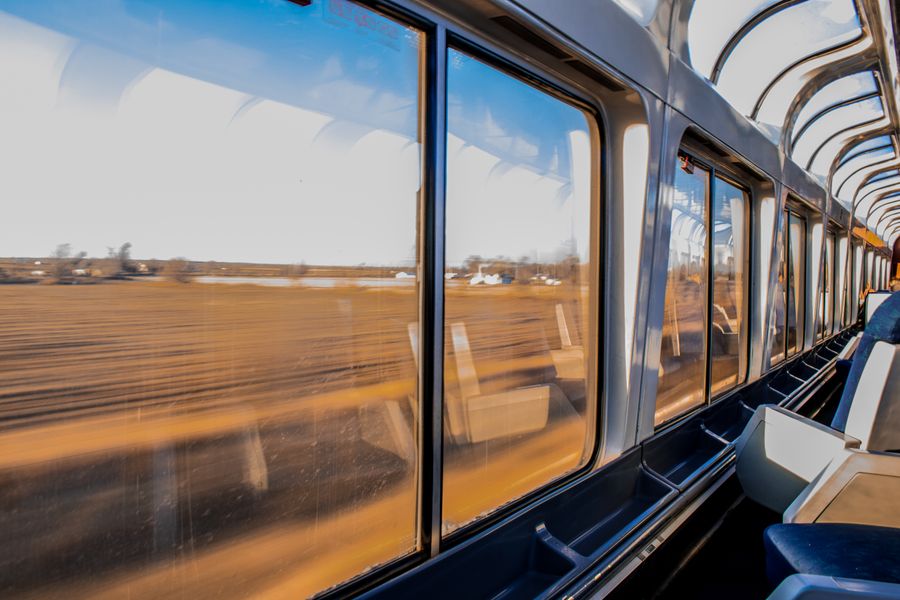
A railway line has a capacity, and it is measured in paths
Track capacity is not measured in trains but in paths: a sequence of times at each point along the route that one train may occupy. Two trains can’t share a path, and a slow train occupies more of the line for longer, which means it consumes capacity out of proportion to its length.
The awkwardness comes from mixing speeds. A railway carrying only identical trains at identical speeds can run them very close together, because they never catch each other. Put a fast passenger service behind a heavy freight and the fast train either crawls or the freight has to be put somewhere out of the way.
That is why the shape of the timetable follows from the mix rather than from demand. A line with heavy freight traffic and a handful of passenger services will look strange to a passenger, because the passenger services are fitted into the gaps left by the traffic that pays for the railway.
Single track turns the problem into a physical one
On double track, opposing trains simply pass. On single track they cannot, and every meeting has to happen at a place where the line briefly becomes two: a passing loop, or a station with a second platform road. The location of those loops decides the whole timetable of the route.
This produces the experience familiar to anyone who has travelled a long single-track railway. The train stops at an apparently unimportant station and waits, sometimes for a long time, and eventually another train appears in the opposite direction. The wait wasn’t a delay; it was the design.
It also explains why one late train makes several late trains. A service that misses its meeting forces the opposing train to wait, and that train then misses its own next meeting further along, so the delay propagates in both directions along a line that has no way to route around it.
Priority is a commercial and political decision
Where passenger and freight services compete for the same path, somebody has to decide which gives way, and the answer differs by country and by ownership. Where the infrastructure is publicly managed and passenger service is a public obligation, passenger trains usually take precedence in the rules.
Where the railway is owned by a freight operator, the relationship can run the other way, and passenger services travel as guests on somebody else’s asset. The passenger timetable is then padded with generous allowances so that it can absorb waiting without being reported as late, which is why some journeys are scheduled at speeds far below what the track permits.
Neither arrangement is obviously right and the argument recurs wherever both kinds of traffic are growing. Freight moved by rail has advantages that most governments want, and so does frequent passenger service, and a line that was built for one of them cannot always be made to deliver both.
Freight runs at night, and that shapes the passenger night too
Much freight moves overnight because the paths are free and because the delivery windows at each end are morning ones. That has two effects on passengers: sleeper services have to be threaded through busy freight traffic, and the engineering possessions that close a line for maintenance are squeezed into the same hours.
The maintenance point is easy to miss. A railway needs the track closed regularly for renewal, and the only time to do it is when neither passenger nor freight traffic is running, which is why weekend and overnight closures cluster and why replacement road services appear at exactly the hours when they are least welcome.
It also explains the odd timings of long-distance overnight trains. Departure and arrival are set by the paths available at each end and by the need to arrive at a socially useful hour, not by the shortest possible running time, so a sleeper may dawdle deliberately or wait somewhere for an hour.
What the mix means for a passenger reading a timetable
A journey time far longer than the distance suggests is usually a capacity story rather than an engineering one. Before concluding that a railway is slow, it is worth noticing whether the route is single track, whether it carries obvious freight, and whether the schedule contains long station dwells at unremarkable places.
The same reasoning identifies which services are robust. A train running on a dedicated high-speed line shares its track with nothing slower and is largely insulated from this class of problem; a train on a mixed rural single-track line is exposed to every other movement on it.
And it is worth appreciating what the freight is doing there. A line that survives at all in a thinly populated region frequently does so because minerals, timber or containers pay for the track, and the two passenger trains a day exist as a consequence of that traffic rather than in spite of it.
Common questions
Why does my train wait for several minutes at a small station?
On a single-track line this is almost always a scheduled meeting with a train coming the other way, since that station has the second track needed for them to pass. It is part of the timetable rather than a delay, which is why no announcement is usually made.
Do freight trains really cause passenger delays?
They can, particularly where a slow heavy train is running ahead of a faster one and there is nowhere convenient to put it aside. Whether it happens depends on the priority rules of the network, which vary considerably between countries and between publicly and privately owned infrastructure.
Why are some scheduled journey times so much slower than the line allows?
Timetables include allowances for congestion, engineering restrictions and recovery from small delays. On a busy mixed line those allowances can be substantial, because a schedule that assumes everything runs perfectly would report almost every train as late.
Staff writer, The Next Postcard
Clara joined to cover cities, slow routes, rail & road and stayed for the awkward questions and reads the small print so you do not have to.


