
Cities
The same streets after dark are a different city
Darkness changes who is out, where it is possible to go and what a place sounds like, which makes a night walk a second reading rather than a repeat of the first.
By Arjun Nair4 min read
Light draws the map after dark
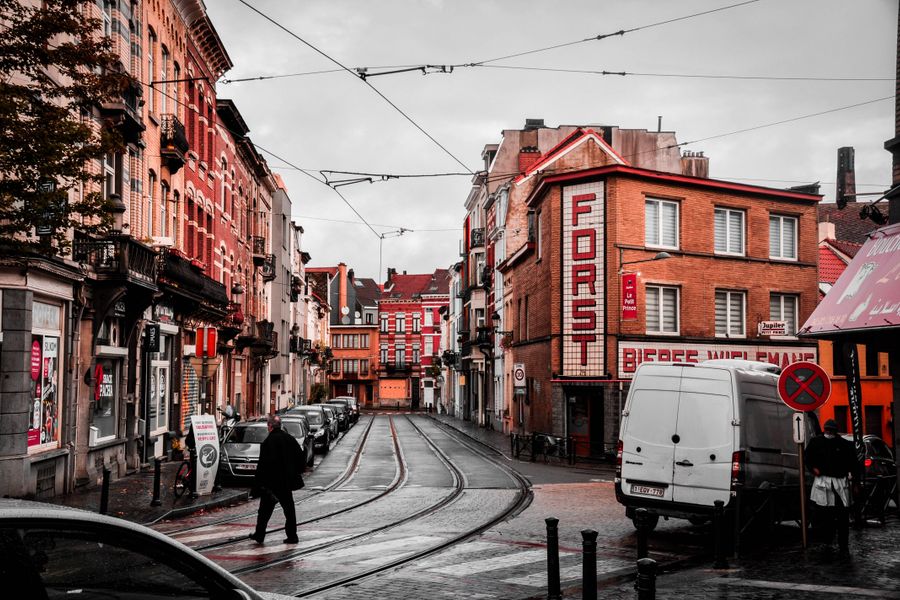
By day a street is navigable everywhere along its length. At night it becomes a chain of lit places connected by darker ones, and the lit places are what you steer between. Street lighting is not distributed evenly and never has been: main routes, junctions and commercial frontages get it, while lanes, parks, underpasses and the backs of things get much less of it.
The effect is that the walkable city shrinks and simplifies. Routes that felt like reasonable shortcuts in the afternoon quietly drop off the list, and everyone converges on a smaller set of corridors. Watch which ones and you have learned something about how the city is actually used, because those corridors are the routes people trust.
The colour of the light matters too, and it has been changing fast as older orange lamps are replaced with white ones. Newer lighting renders colour properly and makes facades legible in a way the orange never did, which is why a district you thought you knew can look unfamiliar after an upgrade.
The population of a street turns over completely
Late evening is a handover. Shops close and their staff leave, the eating and drinking crowd arrives, cleaners and security arrive after that, and somewhere in the small hours the delivery drivers and market traders start. Each of these groups uses the same pavement for entirely different purposes, and they barely overlap.
The interesting hours are the seams between them. Around the moment a district changes hands you can watch shutters coming down on one side of the street while others go up, and see which businesses exist to serve the people who serve everybody else. A cafe that opens at four in the morning has a clientele, and knowing who it is tells you what the district does.
Weekends distort this heavily in cities with a strong going-out culture, to the point where a Friday night reading of a district is not transferable to a Tuesday. If you want the working night, avoid the weekend entirely.
Sound is the sense that gains the most
Traffic noise is the blanket that covers everything else, and when it thins the city acquires detail. You start hearing extractor fans, a distant tram taking a curve, water in a fountain that was inaudible at noon, and the way a narrow street returns your own footsteps to you. Sound also travels further at night for reasons to do with how air temperature is layered, which is why a distant railway can be audible at two in the morning and not at two in the afternoon.
Smell behaves similarly. Bakeries begin work overnight, restaurant extraction runs at full tilt into empty air, and streets that were only visual by day become quite strongly scented ones.
None of this survives in a district built around nightlife, where the noise floor after dark is higher than it ever gets before. The quiet city and the loud city are usually a few hundred metres apart.
Safety is mostly a question of legibility, and it varies
The honest position is that risk after dark differs enormously between cities, between districts of the same city, and between people depending on who they are, so any confident universal claim about night walking is wrong somewhere. What generalises is the reasoning rather than the verdict.
The things worth reading are simple enough. Are there other people around, and are they moving with purpose. Are ground-floor windows lit and occupied. Is there through traffic. A street with a working population and passive overlooking behaves differently from an identical street with neither, and the difference is visible within seconds.
Local knowledge outranks all of it. People who live somewhere know which underpass they would not use and will say so if asked plainly, and that answer is worth more than any general rule about walking at night.
What is only visible after everyone has gone
Empty public space reads completely differently. A square designed to be admired frontally is usually impossible to see that way when it is full of people, and at one in the morning the composition the architect intended is simply there in front of you. The same is true of arcades, bridges and long axial streets.
Illumination is itself a design decision worth attention. Which buildings a city chooses to light says plainly what it thinks is important, and those choices are political as often as they are aesthetic. Some cities floodlight cathedrals and ministries; others light bridges, industrial structures or nothing much at all.
The last stretch, if you can manage the hour, is first light. For twenty minutes or so the night population and the day population are both present, the light is flat and even, and the city is doing the one thing it never does otherwise, which is starting over from empty.
Common questions
Do museums and monuments have late openings worth planning around?
Many do, usually on one fixed weekday evening, and it is among the most underused things in city travel because visitor numbers drop sharply after the late afternoon. Check the institution own listing rather than an aggregator, since these evenings are frequently seasonal or occasional.
Is a night walk a reasonable way to handle jet lag?
It can be, in the sense that being outside gives your body the light cues it needs, though the direction of travel decides whether evening or morning light is the useful one. If you are awake at four anyway, using the hour beats lying in the dark being frustrated by it.
How do I photograph a city at night without carrying equipment?
Look for the half hour after sunset rather than full darkness, because the sky still holds colour while the artificial lights are already on, which balances the exposure. Full night needs support of some kind, and a wall or a railing does the job of a tripod well enough.
Features writer, The Next Postcard
Arjun has written about cities, slow routes, rail & road for most of the last decade and prefers a plain explanation to a clever one.


