
Coast
An estuary is a negotiation between a river and the sea
Where fresh water meets salt, the mixing produces mud, enormous bird populations and the sheltered water that most great port cities were built on.
By Arjun Nair4 min read
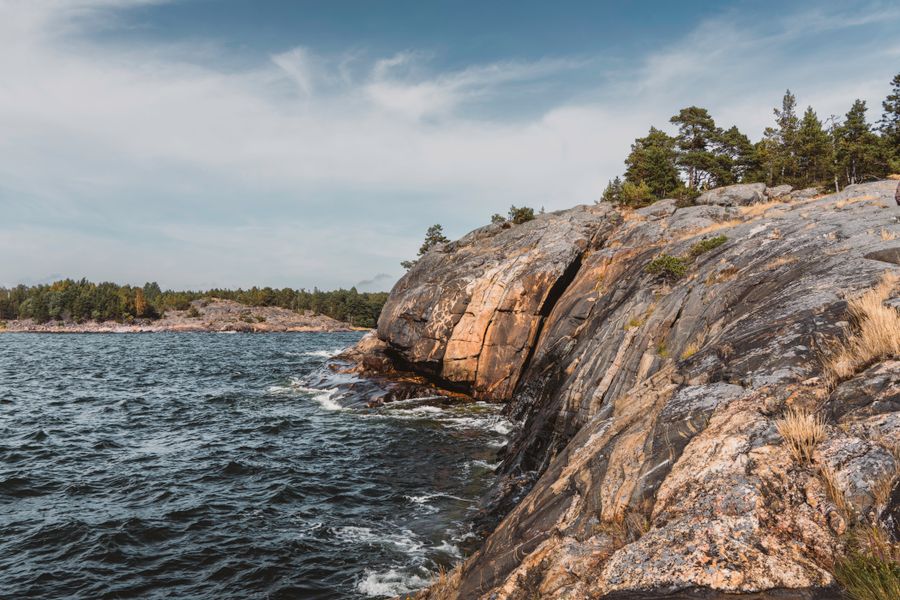
Two waters that mix badly, and the mud that results
Fresh water is lighter than salt water, so where a river meets the sea the two do not simply blend. Fresh water tends to ride over the denser salt water, which pushes upstream along the bed as a wedge on the rising tide, and the boundary between them moves back and forth with the tide and with the river flow.
That meeting has a chemical consequence that shapes the whole landform. Fine clay particles carried in suspension by the river clump together when they meet salt water and settle out, a process that turns water that was cloudy into mud that is deposited. Estuarine mudflats are the accumulated result.
The mud is therefore not a failure of the river to reach the sea cleanly. It is the predictable outcome of the mixing, and it is why estuaries are shallow, why they need dredging to remain navigable, and why they look so different from a rocky coast a few kilometres away.
Brackish water is a demanding place to live
Salinity in an estuary changes with the tide, with the season and with rainfall, so an organism living there must tolerate a range rather than a fixed condition. Relatively few species manage it, which means estuaries have lower diversity than you might expect and enormous numbers of the species that do cope.
That abundance is why estuaries matter so much for birds. Mudflats hold a very high density of invertebrates, exposed twice a day and accessible to waders with the right bill for the depth involved, which is why the same flat supports several species that appear to be competing and are in fact feeding at different levels.
Migration concentrates the effect. Many estuaries are staging points where birds stop to feed on a long journey, so the numbers present depend heavily on the month, and the spectacle of a winter high-tide roost is one of the genuine set pieces of coastal travel in the right latitudes.
Ports chose estuaries for good reasons and then fought them
An estuary offers shelter from the open sea, a deep-water approach at the mouth, fresh water, and a river route inland. That combination is why so many of the great trading cities of the world sit some way up an estuary rather than on the coast itself.
The trouble is that the same sedimentation that makes an estuary is constantly trying to shallow the channel, so navigation has to be maintained by dredging, by training walls that concentrate the flow, and by continual survey. A working estuary port is an engineered system rather than a natural harbour.
As ships grew, many of those inland ports could no longer take them and the business moved downstream to deep water at the mouth. That is why so many estuary cities have a redundant historic dock district in the centre and a container terminal an hour away that nobody visits.
Tidal bores and the strange behaviour of a funnelled estuary
In an estuary that narrows and shallows sharply, an incoming spring tide can be compressed into a single wave that travels upstream against the river flow. These bores occur on a limited number of rivers worldwide, and where they do they are predictable enough to be published as timetables.
They are a striking demonstration of how much energy a large tidal range carries, and they draw crowds, surfers and photographers on the biggest tides of the year. They are also dangerous in the way any fast-moving wall of water is, particularly to anyone standing on the mud in front of one.
Even without a bore, funnelled estuaries have exceptionally strong tidal streams and mud that will not support weight. The combination of soft ground and a fast rising tide is the reason estuary rescues are common and why local warnings about crossing flats are meant literally.
What makes estuaries rewarding to travel around
They are not conventionally scenic in the way a cliff coast is, and that keeps them quiet. Big skies, flat ground, sea walls that make excellent long walking routes, small ports, isolated churches on slightly higher ground, and light that changes constantly because there is so much water and so much sky reflecting it.
They also have unusually complete infrastructure for walking and cycling, because flood defences run continuously for long distances and are frequently public rights of way. A sea wall path gives you a raised, level route with the flats on one side and farmland on the other.
Access is the one real constraint, since the same flatness makes crossings rare. A short distance across the water can be a very long way round by road, and where a ferry exists it may be seasonal or tidal, which turns estuary travel into a matter of studying the map properly before setting out.
Common questions
Why is estuary water brown even when it is clean?
Because it carries suspended fine sediment brought down by the river and stirred up by tidal currents over mudflats, which has nothing to do with pollution. Clarity in an estuary is generally a measure of how much sediment is moving rather than of water quality.
When is the best time to see birds on an estuary?
A rising tide is the classic window, because the flats shrink and push feeding birds closer together and closer to the shore, culminating in a roost at high water. Season matters as much as tide, since many estuaries are busiest during migration periods and in winter.
Is it safe to walk out onto estuary mudflats?
Frequently not, and this is one of the areas where local warnings should be taken at face value. Soft mud, channels that fill first and a tide that advances across flat ground faster than walking pace combine badly, and guided walks exist on some flats precisely because unguided ones go wrong.
Features writer, The Next Postcard
Arjun has written about cities, slow routes, rail & road for most of the last decade and prefers a plain explanation to a clever one.


